FAQs
Low Voltage & Smart Home Questions, Answered
Straight answers about low voltage installation, smart home systems, security and structured wiring - from a licensed C-7 contractor serving San Diego through Los Angeles. Jump to the section you need, or browse everything below.
Jump to a topic
General Questions
What services does Low Voltage Components offer?
We design and install structured wiring, home theater and audio/video systems, TV mounting with concealed cabling, whole-home audio distribution, wired and wireless networking, security cameras and video doorbells, security systems, home automation, and lighting and shade control for new construction and existing homes. See the full list on our Services page.
Are you licensed and insured?
Yes. Low Voltage Components holds a California C-7 Low Voltage Systems contractor license (CLSB License #1056087) and carries full liability coverage.
What areas do you serve?
We are based in Escondido, CA and serve homes and businesses from San Diego to Los Angeles - including North San Diego, Orange County, Riverside, and the Inland Empire. We work regularly in Carlsbad, Encinitas, Del Mar, Rancho Santa Fe, Fairbanks Ranch, Poway and San Marcos. See all service areas.
Do you work on new construction, or only existing homes?
Both. We regularly partner with builders and homeowners to pre-wire new construction for networking, audio/video, and security before drywall goes up, and we retrofit existing homes with the same systems. Our pre-wire checklist shows what belongs in a build.
Can you mount my TV and hide the cables?
Yes. TV mounting with concealed wiring is one of our most requested services - we route cables inside the wall so there is no visible cord. See the most common TV mounting mistakes we get called in to fix.
How do I get a quote?
Call (310) 702-0504 or fill out the form on our Contact page, and we will schedule a free consultation to assess your project.
Do you subcontract your work out to other crews?
No. David, the owner, is on every job. You get one licensed point of contact from the walkthrough through programming and handoff - not a rotating crew and not a call center. You can read more about how we work on our About page.
How long does a typical installation take?
It depends entirely on scope. A single TV mount with concealed wiring is usually a few hours. A whole-home network and structured wiring package in an existing home is typically one to three days. A new construction pre-wire is staged across the build - rough-in before drywall, then trim-out and programming after paint. We give you a realistic timeline in writing before we start.
What brands do you install?
We install and program Control4 and Lutron, and we work with Triad, KEF, Episode, Ubiquiti, Araknis, Luma and other professional-grade lines. We are not locked to a single manufacturer - we spec what actually fits the home and the budget. If you are weighing platforms, our guide comparing Control4, Lutron and Savant breaks down the real differences.
Do you provide support after the installation is finished?
Yes. Every system is labeled, documented and walked through with you before we leave, and we stay reachable for questions, tweaks and future expansion. Because we pre-wire with room to grow, adding a camera, a zone of audio or another access point later is usually a small job rather than a rebuild.
TV Mounting
Flush mounts, articulating arms, over-fireplace installs and fully concealed cabling.
Can you hide the TV wires without tearing up my wall?
Yes. In almost every case we fish power and HDMI inside the wall cavity and terminate into a recessed outlet behind the TV, which means one small opening behind the screen and one near the outlet - both hidden. On solid masonry, brick or a wall we cannot open, we use a low-profile surface raceway painted to match. We tell you which applies before we start, not after. Full details on our TV mounting page.
Is it safe to mount a TV above my fireplace?
Sometimes, but it is the single most over-requested mount we talk people out of. Two things decide it: heat coming off the firebox, and viewing angle. If the mantel throws heat straight up the wall, it will shorten the TV's life. If the screen ends up too high, you will be craning your neck every night. We measure both and recommend a pull-down mount, a different wall or a different room when the numbers do not work. This is one of the mistakes that costs homeowners the most.
Can you mount a TV outside on a patio?
Yes, with the right hardware. Outdoor installs need a weather-rated display, a corrosion-resistant mount, GFCI power and shaded placement - a standard indoor TV on a covered patio will fail in San Diego's coastal air. We handle the wiring, mounting and audio together so the patio actually sounds as good as it looks. See our guide to wiring an outdoor living space.
Learn more: TV Mounting Service
Home Theater
Dedicated theaters and media rooms - screen, projector, surround sound, seating and acoustics.
What is the difference between a media room and a dedicated home theater?
A media room is a living space that also does movie duty - ambient light, existing furniture, a large TV and a surround system tuned around the room you already have. A dedicated theater is a purpose-built room: controlled light, acoustic treatment, a projector and screen, tiered seating and speakers placed to specification. Both can sound excellent. The dedicated room simply removes the compromises. We build both - see our home theater page.
Projector and screen, or a large TV?
Screen size and light control decide it. Under about 100 inches in a room with windows, a large TV is usually the better and more reliable picture. Above that, in a room you can darken, a projector gives you cinema scale that no panel matches. We measure throw distance, seating distance and ambient light before recommending either. Our home theater planning guide walks through the decision.
How many speakers do I actually need for surround sound?
For most media rooms, a 5.1.2 layout - five surround speakers, a subwoofer and two in-ceiling height channels for Dolby Atmos - is the point where the room stops sounding like a TV and starts sounding like a theater. Dedicated rooms often go to 7.2.4. More speakers in the wrong positions sound worse than fewer in the right ones, so placement and calibration matter more than count. We can also extend audio to the rest of the house with whole-home audio.
Learn more: Home Theater Installation
Whole-Home Audio
In-ceiling, in-wall, outdoor and multi-room audio that plays independently in every zone.
Can different rooms play different music at the same time?
Yes - that is exactly what a zoned system does. Each room is its own zone with its own volume and its own source, so the kitchen can play one thing while the patio plays another and the primary bedroom stays silent. Everything is controlled from your phone, a wall keypad or voice. See our whole-home audio page.
Is Sonos as good as in-wall wired speakers?
They solve different problems. Sonos is excellent when you cannot run wire and you want flexibility - it is wireless, simple and sounds good. Wired in-ceiling and in-wall speakers disappear into the architecture, never drop off the network, never need charging or firmware babysitting, and deliver noticeably better sound per dollar at the higher end. In a home being built or renovated, wire it. In a finished home where opening walls is not on the table, Sonos is a legitimate answer. We install both.
Can you put speakers outside by the pool or patio?
Yes. Outdoor audio needs weather-rated speakers and proper amplification - patios are open spaces without walls to reinforce sound, so undersized speakers just sound thin. We typically use a combination of landscape satellites and a buried subwoofer to get even coverage without one loud speaker blasting the neighbors. See our roundup of outdoor speaker systems for San Diego patios and pools.
Learn more: Whole Home Audio System Installation
Security Cameras & Video Doorbells
Wired camera systems, local recording and doorbell cameras that actually hold up.
Wired or wireless cameras - which should I get?
Wired, whenever the walls allow it. Wireless cameras depend on battery life, Wi-Fi coverage and a cloud subscription, and they are the first thing to fail in a real incident. A wired PoE camera gets power and data over one cable, records locally to an NVR, and keeps working when the internet does not. Wireless makes sense for a rental or a spot you truly cannot reach. Details on our camera installation page.
Do I have to pay a monthly subscription to store footage?
Not with the systems we install. We record locally to an on-site NVR, which means your footage stays on your property and there is no recurring cloud storage fee. Remote viewing from your phone still works. Cloud storage is available as an option if you want off-site redundancy, but it is a choice rather than a requirement.
Will my HOA let me install a video doorbell?
Usually yes, but the rules vary and they tend to cover the doorbell's appearance and where it can point - not whether you can have one. Communities in Rancho Santa Fe, Fairbanks Ranch and Del Mar are often the strictest. We install hardwired doorbells that replace the existing chime wiring, which keeps the exterior change minimal and generally sails through approval. See our Rancho Santa Fe page for how we handle estate communities.
Learn more: Security Camera Installation
Security Systems
Alarm systems, sensors, and monitoring integrated with the rest of the home.
How is a custom security system different from an ADT or Ring package?
The big-box package is built for volume: standardized equipment, a long monitoring contract, and a system you do not own. A system we design is specified around your actual floor plan and entry points, hardwired where it matters, integrated with your cameras, lighting and locks, and yours outright. You choose the monitoring provider rather than inheriting one. Compare on our security systems page.
Is monitoring required?
No. A system can run entirely self-monitored, sending alerts straight to your phone with no monthly fee. Professional monitoring adds a service that dispatches when you cannot respond - worth it if you travel or own a second property, unnecessary for plenty of homeowners. We build the system so you can add or drop monitoring later without replacing hardware.
Can my security system talk to my cameras and lights?
Yes, and that is the real advantage of having one contractor do all of it. A tripped sensor can pull up the nearest camera, turn on exterior lighting and send a clip to your phone in one action. That only happens when the alarm, the cameras, the lighting and the automation platform are designed together rather than bolted on by three different companies.
Learn more: Home Security System Installation
Home Networking & Structured Wiring
Structured wiring, enterprise-grade Wi-Fi, and the wired backbone everything else depends on.
Why is my Wi-Fi still bad after I bought an expensive router?
Because one router in one location cannot cover a whole house, no matter what it cost. Range is limited by walls, stucco with wire lath, and distance. The fix is not a bigger router - it is multiple hardwired access points placed to cover the actual floor plan, each fed by ethernet. That is a wiring problem, not a hardware problem. Our guide on why your router is not enough explains it in detail.
Do I really need ethernet if everything is wireless now?
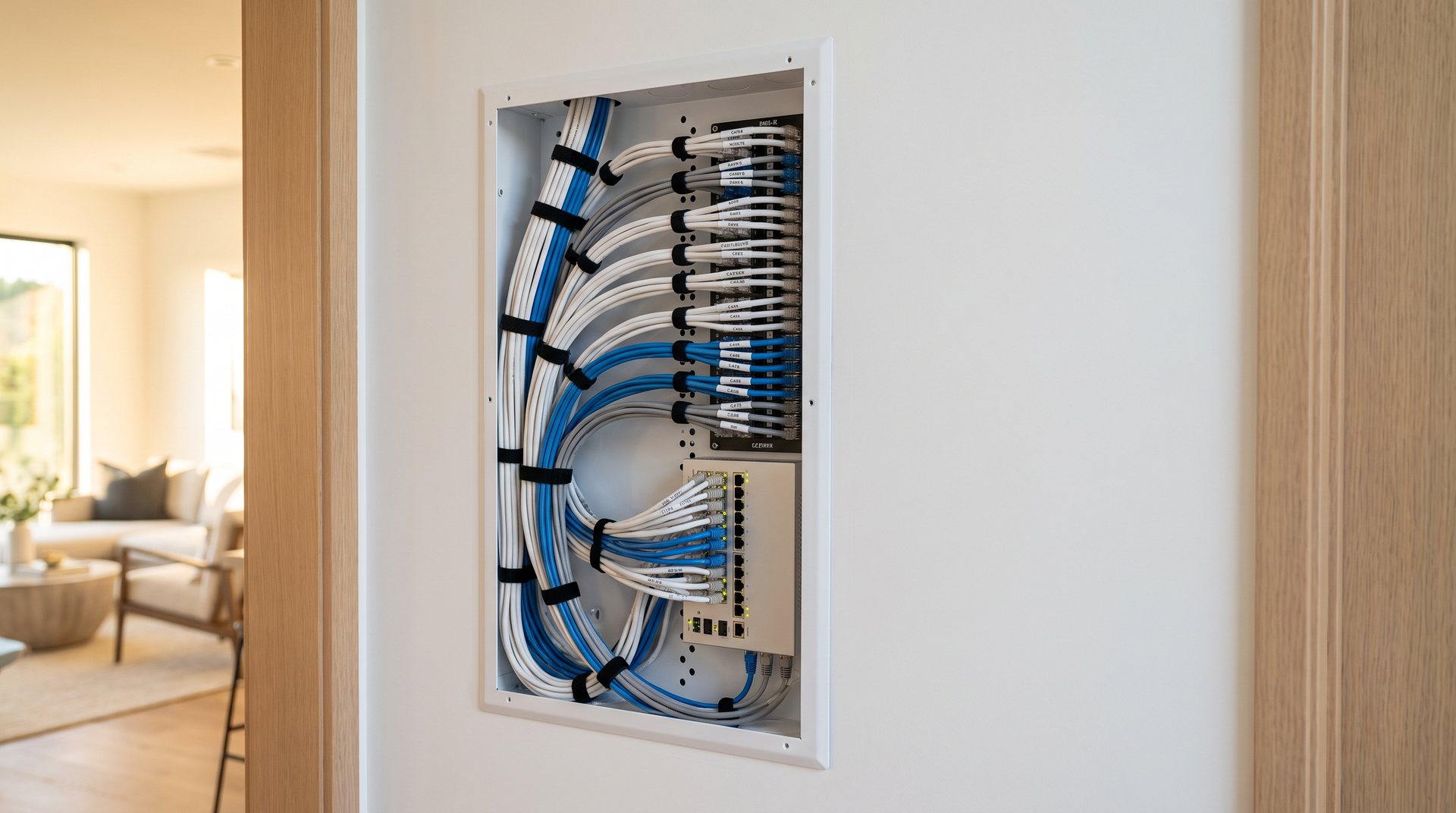
Yes. Every wireless device still reaches the internet through a wire somewhere - the question is only whether that wire is in the right place. Access points, cameras, TVs, streaming boxes, control processors and NVRs all perform better hardwired, and a wired backbone is what makes the wireless part reliable. Structured wiring is the cheapest thing you will ever do in a house and the most expensive to add later. See our network design page.
What kind of cable should be run in a new build?
Cat6 handles gigabit comfortably and is the sensible default for most runs. Cat6a is worth it for longer runs, access points and anything you want future-proofed to 10 gigabit. Fiber makes sense between floors or outbuildings and for the main backbone in larger homes. We usually run a blend rather than one cable everywhere. Our breakdown of Cat6 vs Cat6a vs fiber covers where each one earns its cost.
Learn more: Home Network Installation
Home Automation
Control4, Lutron and integrated control that ties every system into one interface.
What is the difference between smart home gadgets and a real automation system?
Gadgets are individual products with individual apps - a smart bulb here, a smart lock there, five apps and no coordination. An automation system is one platform that owns all of them, so a single button does lights, shades, audio, HVAC and locks together. It also keeps working when a manufacturer changes an app or discontinues a product line. See our home automation page.
Control4, Lutron or Savant - which platform is right for my home?
We install and program Control4 and Lutron. Control4 is the broadest integrator and the usual choice when you want one system running audio, video, security, HVAC and lighting together. Lutron is the strongest lighting and shade platform in the industry and often runs alongside Control4 rather than instead of it. Savant is excellent but a narrower fit. We spec based on what you actually want to control - our comparison of Control4 vs Lutron vs Savant lays out the tradeoffs.
Will the system still work if my internet goes down?
Yes, for anything local. A properly designed system keeps lighting scenes, shades, keypads, audio and locally recorded cameras running on the home network with no internet at all. What you lose is remote access from outside the house and any cloud-dependent streaming service. That is a deliberate design choice - we keep the critical functions local rather than routing them through someone else's server.
Learn more: Home Automation Installation
Lighting & Shade Control
Lutron keypads, dimming, scenes and motorized shades wired in from framing.
Do motorized shades have to be wired, or can they be battery powered?
Both exist. Battery shades are the right call in a finished home where opening walls is not practical - they run one to three years per charge and install cleanly. Hardwired shades never need charging, move faster and quieter, and are the obvious choice if the walls are open. If you are building or remodeling, run the wire. Details on our lighting and shade control page.
What does a lighting control system do that regular dimmers do not?
It replaces a wall of individual switches with a small keypad where one button sets an entire room or an entire floor at once - and it lets that happen automatically. Shades drop at sunset, path lighting comes up at ten percent overnight, everything goes off when you leave. It also cleans up the wall aesthetically, which is often what people notice first.
Can lighting and shades be added to a house that is already finished?
Yes. Lutron's retrofit lines were designed for exactly this - wireless dimmers and keypads that replace existing switches without new wiring, paired with battery shades. You get the majority of the experience without opening drywall. If a remodel is coming, we will tell you which parts are worth waiting to hardwire. We also handle new construction where everything is wired from framing.
Learn more: Lighting & Shade Control Installation
New Construction & Pre-Wire
Working with builders, architects and homeowners to wire it right before drywall.
When in the build should I bring in a low voltage contractor?
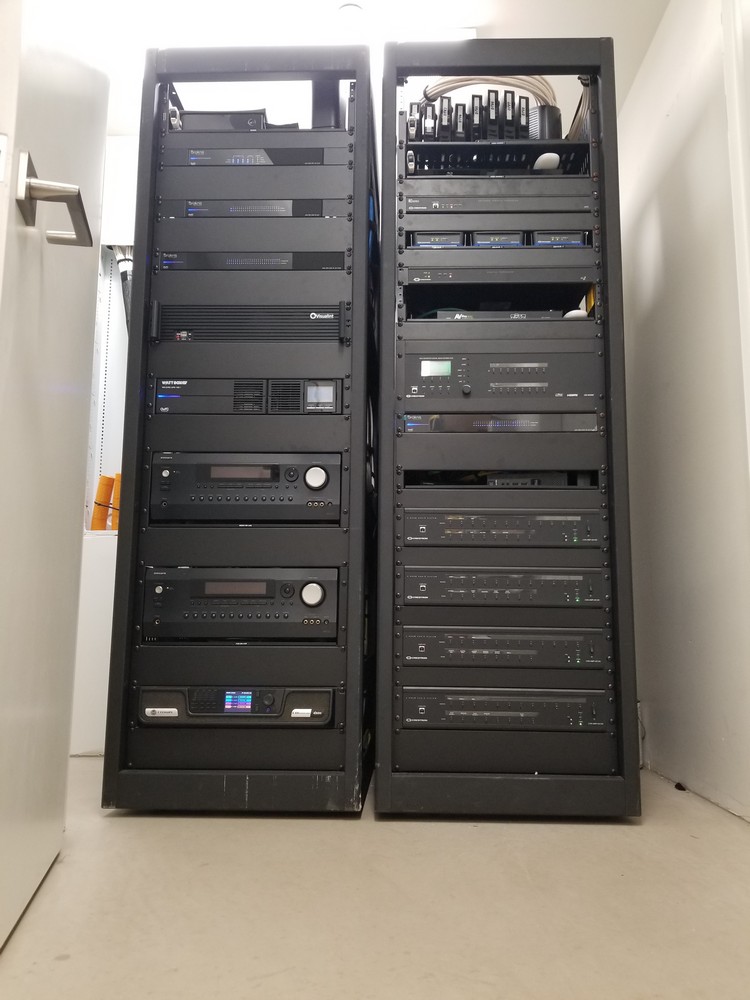
At framing, before insulation and drywall - and ideally at the plan stage before that. The rough-in has to happen in the window between framing and drywall, and if you miss it, every wire afterward means opening finished walls. Getting us in during design also catches the things that are free to fix on paper and expensive to fix in the field: rack location, conduit runs, TV wall placement, speaker locations. Our pre-wire checklist for San Diego builders is a good starting point.
Doesn't my electrician already handle low voltage wiring?
Most do not, and California licensing is the reason to check. Low voltage systems fall under a C-7 license, which is separate from the C-10 electrical license. An electrician can pull wire, but structured wiring, audio, network and security have their own standards for cable type, separation from line voltage, termination and testing. Getting it wrong shows up as a network that will not hold speed or a speaker run with hum in it - after the walls are closed. We hold an active C-7 (CSLB #1056087).
What should be pre-wired even if I am not installing the system yet?
Run the wire for everything you might plausibly want, and terminate what you are using now. At minimum: ethernet to every TV location and every ceiling access point position, speaker wire to the rooms you would ever want audio in, camera drops at the corners of the house and the front door, and conduit from the rack to the attic and to the exterior. Wire is cheap during framing and expensive forever after. We work directly with builders on custom homes and new construction.
Learn more: Custom Homes & New Construction Wiring
Where We Work
Based in Escondido and working from San Diego to Los Angeles - including North San Diego County, Orange County, Riverside and the Inland Empire.
Escondido · Carlsbad · Encinitas · Del Mar · Rancho Santa Fe · Fairbanks Ranch · Poway · San Marcos
Still have a question?
Call (310) 702-0504 or send us the details of your project and we will get you a straight answer - no pressure, no sales script.